Chapter OneDiscovery?
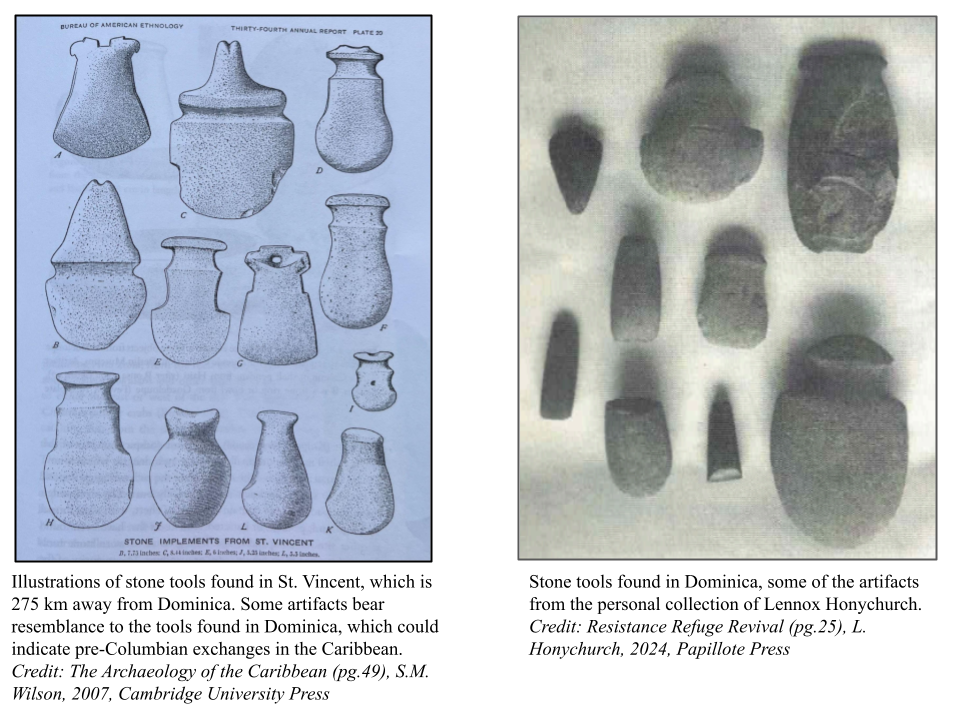
The island the maps later called Dominica was already named, already inhabited, already part of a regional trade network long before the framing of European discovery was applied to it. The Kalinago people called it Waitukubuli, meaning tall is her body, and held the island as part of a larger Caribbean world that moved goods, ideas, and people between the Lesser Antilles for centuries before contact. The arrival of European ships into that world did not initiate Caribbean history. It interrupted it.
The framing of discovery has done a particular kind of damage in the Caribbean, and Dominica is where some of that damage is most legible. The Kalinago manifested over generations into a distinctive group with its own political organization, language family, and territorial sense. Early European chroniclers read that distinctiveness as hostility and used the reading to justify what came next. The result, as Honychurch and others have argued, was to unnecessarily separate groups of people while excluding the Kalinago from their crucial role in developing the cultural landscape that imperial cartographers would later claim to have authored.
What the archaeology now makes plain is that Waitukubuli was an active node, not a blank slate. The earliest layers at the sites discussed in the next section show pre-Columbian occupation with material connections to neighboring islands, and the cultural landscape the Europeans encountered was already legible as a landscape, with paths, fishing grounds, garden sites, and gathering places. The question of whether Columbus discovered Dominica is, in this light, the wrong question. The right one is what was already there, who was keeping it, and how that work continued underneath every empire that came after.
The Kalinago manifested into its own distinctive group and were mistaken for a separate identity, unnecessarily separating groups of people while excluding the Kalinago from their crucial role in developing the cultural landscape of Dominica.
Chapter TwoDominica, the Trading Colony
Before Dominica became a Sugar Age colony it was a trading colony, and the difference matters. Trading colonies are places where exchange happens on terms at least partially set by the local population. Plantation colonies are not. The transition from one to the other in Dominica is one of the central stories the cultural landscape still tells, and the archaeology at La Soye is one of the clearest places to read it.
La Soye is a complex of four sites at Woodford Hill in Saint Andrew Parish on the northeast coast, excavated by a multi-institution team drawing researchers from Leiden University, Northwestern University, and the University of South Florida. The material recovered there documents pre-Columbian inter-island trade that predates European arrival and continues into the early contact period. Sherds, faunal remains, and lithic material from La Soye place Dominica firmly inside a regional Caribbean trade system that did not require European mediation to function.
What La Soye 1 through 4 also document is the slow encroachment of European presence onto that system. The sites contain layers of contact-era material that show the trading colony posture lingering well after the political map of the Caribbean had been redrawn. For a long while, exchange continued on something close to the original terms. Then it did not. The shift from trading colony to plantation colony was neither immediate nor consensual, and the archaeological record is the place where the timeline of that shift is being slowly, carefully reconstructed.
Fort Shirley and Scotts Head show how Britain had a complex strategy covering fortification against Kalinago raiders and rebel slaves while displaying military dominance.
Chapter ThreeBattle of the Empires
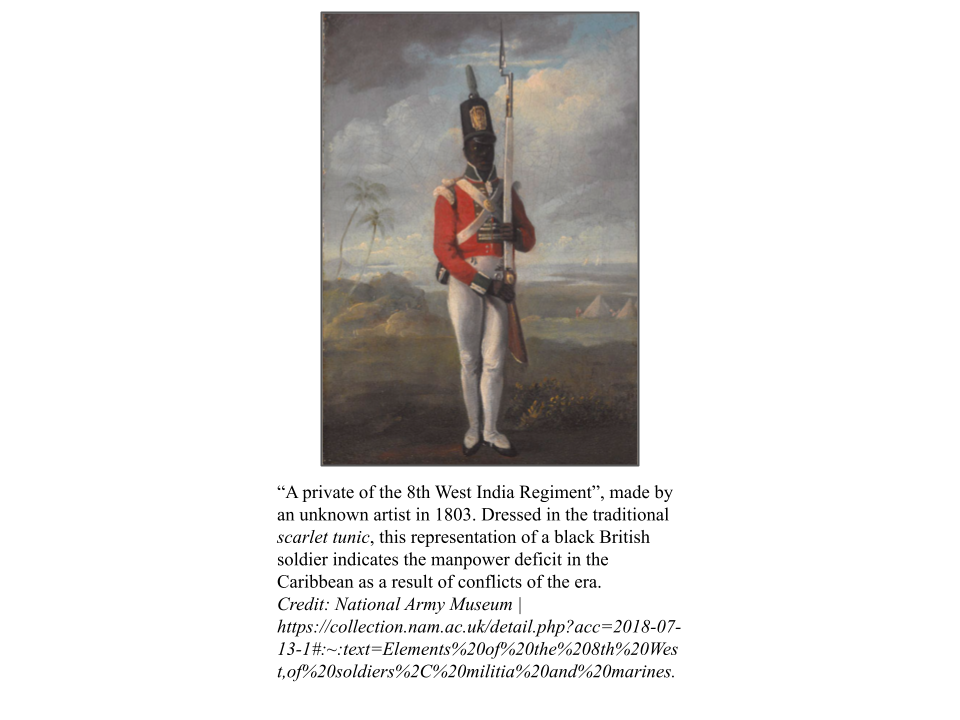
Dominica sits between Guadeloupe to the north and Martinique to the south, and that geography placed it in the path of every imperial contest in the eastern Caribbean for three hundred years. The Treaty of Saint Christopher in 1660 formally recognized Kalinago sovereignty over Dominica and Saint Vincent, attempting to create a neutral zone between French and British holdings in the region. Planters of all four major imperial powers, British, French, Dutch, and Spanish, proceeded to ignore that recognition almost immediately and almost completely.
The military architecture of that ignoring is still on the landscape. Fort Shirley sits on the Cabrits Peninsula at the island's northwestern tip, a British garrison complex that controlled the channel between Dominica and Guadeloupe. Scotts Head guards the southern approach, the place where the calm Caribbean meets the open Atlantic. Together they bracket the island, and together they tell a particular story about the British strategic posture during the long eighteenth and nineteenth centuries. The fortifications were not only outward facing. Britain had a complex strategy covering fortification against Kalinago raiders and rebel slaves as well as against the imperial rivals across the water.
The structures are still there because they have been intentionally preserved as heritage assets, not because they survived neglect. That preservation choice is itself part of the story. Fort Shirley today reads as a heritage site, a public park, a place a visitor walks through. The eighteenth century military function and the twenty first century interpretive function are layered on the same stone, and the cultural landscape carries both layers at once.
Chapter FourRise and Plateau of the Sugar Age
The Sugar Age transformed Dominica from a trading colony into an agricultural powerhouse in an immensely short timespan. Land that had been worked under one regime of exchange was repurposed as plantation, and the cultural landscape took on the morphology of a sugar economy: terraced slopes, mill ruins, road networks oriented toward shipping points, and population centers arranged around plantation infrastructure rather than around the older coastal trade sites.
That transformation was driven by enslaved labor. The demographic record is unambiguous on this point. The plantation economy in Dominica, as across the eastern Caribbean, depended on the forced labor of African and African-descended people, and the violence required to maintain that dependence shaped both the human and the physical landscape. Maroon communities formed in Dominica's mountainous interior, drawing on the terrain that made the island difficult to fully police. The Indian River corridor, and the inland watersheds it drains, became one of the routes by which Maroon settlements communicated, traded, and at moments coordinated.
Slave and Maroon rebellions ravaged European colonies across the Caribbean during the Sugar Age, and Dominica was part of that pattern. The archaeological record of the period is therefore not the record of an unbroken plantation system. It is the record of a system that was constantly being contested from inside. The cultural landscape that emerges from that period has plantation infrastructure as its most visible layer, but it has resistance as its substrate, and the substrate is what survives.
The phrase colony within a colony is used by Lennox Honychurch to describe the Kalinago Territory. Dominica itself was a territorial possession of the British empire; carving out a space for the Kalinago to coexist was essentially the inception of a new colony.
Chapter FiveKalinago Territory and Decolonization
The Kalinago Territory exists today as a roughly 3,700 acre reserve on the eastern coast, formalized under British administration and continued under the Commonwealth of Dominica. Lennox Honychurch's framing of the Territory as a colony within a colony captures what is structurally singular about it. Dominica itself was a territorial possession of the British empire, and carving out a separate space for the Kalinago to coexist was essentially the inception of a new colony, a smaller jurisdiction whose terms of recognition were set externally and whose boundaries were drawn on someone else's authority.
The colonial administrative history of the Territory is well documented through the surveys carried out by Hesketh Bell and his successors. What the surveys do not capture, and what the cultural landscape does, is the long quiet work of continuity. Kalinago presence on Dominica did not pause and resume at the convenience of British administrators. It continued throughout, often outside the visibility of the colonial record, and it is one of the most direct sources of contemporary Dominican identity.
The road to independence ran through specific incidents. The La Plaine tax riot of 1893 is one of them. The dispatch of Buffalo Soldiers and other imperial troops to enforce colonial order in the Caribbean is another, and the Bob Marley line that gave a later generation a way to name that pattern is yet another. The Commonwealth of Dominica was inaugurated in 1978, and independence was less an arrival than a recognition. Dominicans were already, by then, becoming a people in their own right, and the landscape had been recording that becoming for centuries.
ConclusionReclamation of the Cultural Landscape
The thesis the capstone arrives at is a quiet one. The process of Dominicans becoming a people in their own right is reflected throughout the landscape, and the raw history of contact, conflict, and resistance is embedded in the archaeological record. Heritage preservation, on this reading, is not a matter of freezing a moment. It is a matter of keeping the record legible so that the becoming can continue.
Three vectors carry that work forward in present day Dominica. Community archaeology, exemplified by the continued multi-institution work at La Soye, brings local stakeholders into the interpretive process rather than treating them as subjects of study. Heritage tourism, organized around the forts, the Kalinago Territory, the river systems, and the Sugar Age ruins, channels economic value back into the landscape that produced it. And policy work, both at the national level and through partnerships with bodies such as UNESCO, formalizes protection of sites whose vulnerability is otherwise ambient.
None of these vectors is complete. None resolves the longer histories that produced the present landscape. Together they argue, instead, for resilience as a posture rather than a state. The Sugar Age sites are being reclaimed by the natural landscape. The cultural landscape is being reclaimed by the people who live on it. Both processes are ongoing, and both are the subject this first issue of Blarg Papers exists to track.
The process of Dominicans becoming a people in their own right is reflected throughout the landscape. The raw history of contact, conflict and resistance is embedded in the archaeological record.